
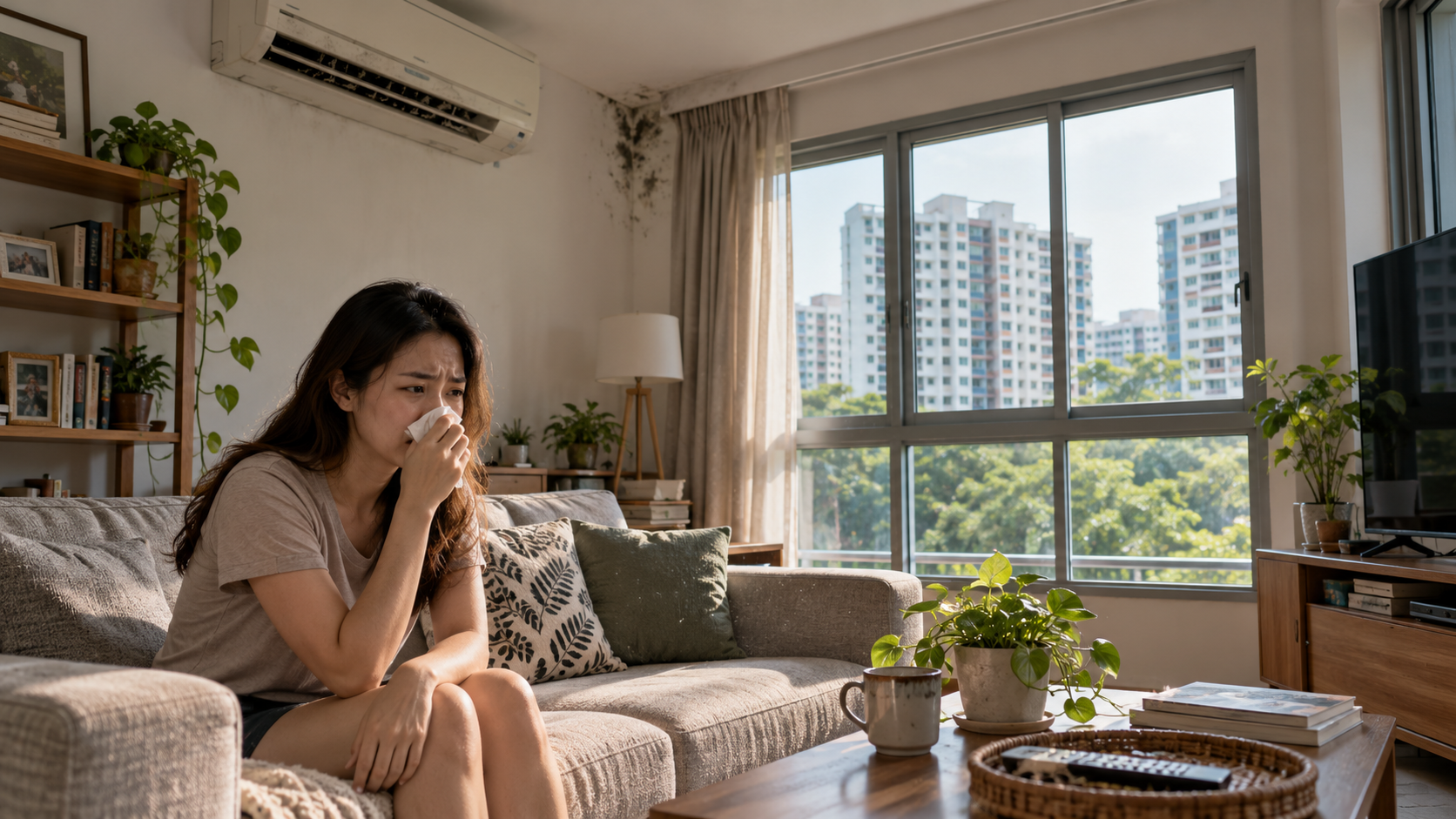
For most of this autumn, Singaporeans have watched the skyline disappear behind smoke haze and been told to stay indoors. That advice only works if the air inside is better than the air outside, and it often isn't.
In October 2026 the National Environment Agency published an updated version of its guidance on ventilation and indoor air quality. First written in May 2020 to fight COVID-19, it has been reframed around a broader goal: a healthy indoor environment all year, whether the threat is a virus, haze or pollutants from inside the building itself. Here is what it says, why it matters now, and what you can do about it.
Why indoor air matters more than ever in 2026
The 2026 haze season has been the worst in a decade. The 24-hour PSI first crossed into the unhealthy range on 4 September, the first time since October 2023. By mid-October Singapore had logged 12 straight days of unhealthy air, the longest run since the 2015 crisis, and readings reached the “very unhealthy” band above 200 for the first time this year. A strong El Niño, which dries out the region and lets fires in Sumatra and Kalimantan spread, is a big part of the reason.
The health toll is visible. GPs and telemedicine providers reported a 20 to 30% rise in haze-related complaints such as asthma flare-ups and eye irritation, and community clubs opened air-conditioned rooms as public haze shelters.
But haze is only one way indoor air goes wrong. NEA's Environmental Health Institute lists three main risks: poor ventilation, chemical pollutants from products and activities, and outdoor PM2.5 leaking in. A 2018 survey of air-conditioned shophouses found 90 of 100 units had no outdoor air supply at all, and pollutant levels were highest where sources like nail-care products were in use. The NEA guidance itself links poor indoor air to more infectious disease transmission, eye, nose and throat irritation, and respiratory and heart disease.
What NEA's updated guidance asks of buildings
The guidance is written for building owners and facilities managers of non-residential premises, both air-conditioned and naturally ventilated. Hospitals, polyclinics, laboratories and factory production areas are excluded because they need specialist advice. Its message is simple: bring in enough outdoor air, filter what comes in and what recirculates, and keep the system maintained.
Start with a plan. Commercial and public spaces should have a written ventilation and indoor air quality plan, reviewed regularly. It should reflect the type of ventilation, how crowded the space gets, thermal comfort and humidity.
Buildings with central air-conditioning and mechanical ventilation
- Supply at least the minimum outdoor air rates in SS 553:2026, and consider sensors to check them.
- Check daily that air handling units, fan coil units and fresh-air and exhaust fans are running, especially in occupied spaces.
- Make sure diffusers and exhaust grilles move air the right way, and balance the system so every room actually gets outdoor air.
- Inspect fans, ducts and dampers for leaks and blockages, and check that filters are sealed so air cannot bypass them.
- Find and fix unwanted leaks into occupied spaces, such as dried-out floor-trap water seals, cracked pipes and gaps in walls.
- Consider purging the air before each occupancy, or running the system with outdoor air intake for a while before people arrive.
- Use filters rated at least MERV 14, F8 or ePM1 70–80% for both outdoor and recirculated air, or at least make sure the system can take them during an epidemic or a haze episode.
- Change filters only with the system off, bag used filters, and protect staff with at least an N95 mask, eye protection and gloves.
Air-conditioned spaces without mechanical ventilation
Offices and shops cooled by split units with no fresh-air supply need special attention, since these are where the shophouse survey found the worst air.
- Open windows and doors as often as possible unless outdoor air quality is poor, and turn the air-con down or off while they are open.
- Run toilet and kitchen exhausts at full capacity, and consider window-mounted exhaust fans meeting SS 553:2026 air-change rates. Pairing supply and exhaust fans creates a one-way airflow through the room.
- For haze, fans can be fitted with covers to close them off, or replaced over time with filtered supply fans rated MERV 14 or equivalent.
- In higher-risk enclosed spaces, portable HEPA air cleaners can serve as an interim measure. Size them by clean air delivery rate and switch off any ozone-generating function. NEA is clear that air cleaning does not replace ventilation.
- Upper-room ultraviolet disinfection is an option where ceilings are high enough, installed so that occupants' eyes and skin are not exposed.
Homes get one line of advice: open doors and windows and use fans as needed.
The standards behind it, and the one number to watch
Singapore has no law setting indoor air quality limits. Instead, two Singapore Standards do the heavy lifting, and the updated guidance now points to their 2026 editions.
The SS 554 revision updates its pollutant limits against the latest national and international data and adds a quicker screening option alongside a full air quality audit. Building owners can also earn recognition through BCA's Green Mark scheme, and low-emission paints, adhesives and furniture are labelled under green building product schemes.
For everyday checking, the most useful number is carbon dioxide. People exhale CO₂, so a rising level means stale air is not being replaced fast enough. NEA's CO₂ monitoring advisory, updated in April 2026, sets two marks for enclosed air-conditioned spaces:
- Below 800 ppm: the recommended target, averaged over the measurement period. Above it, managers should act to improve ventilation or reduce crowding.
- About 1,100 ppm: the SS 554 ceiling that should never be exceeded, based on 700 ppm above outdoor levels.
NEA recommends non-dispersive infrared meters, which are inexpensive and widely sold. One caveat: CO₂ shows how well a room is ventilated, not whether the air is clean. During haze, a well-ventilated room can still be full of PM2.5 if its filters are poor.
Putting it into practice
The hard part is that ventilation and haze pull in opposite directions. NEA's scientists call it a trilemma: during an outbreak you want lots of outdoor air, during haze you want to keep it out or filter it hard, and in normal times you want just enough to balance air quality against energy use. The right move depends on the day.
At home
- On clear days, open windows and doors and let fans move air through.
- On haze days, check the PSI and PM2.5 readings on haze.gov.sg or the myENV app, close up, and run an air purifier with a HEPA filter sized for the room.
- Use the kitchen hood when cooking and the bathroom exhaust after showers.
- After painting or buying new furniture, air the room out for several days, and pick low-emission products where you can.
At work
- Ask your building or office manager whether there is a ventilation plan and what filters the system uses.
- A small CO₂ meter on a meeting-room table quickly shows whether the room is under-ventilated at peak use.
- If you run a shop, salon or clinic cooled by split units, assume you have little or no fresh air until you check. Exhaust fans and opening up between customers help.
For building owners and facilities managers
- Write or update the ventilation and air quality plan against SS 553:2026 and SS 554:2026.
- Upgrade to MERV 14 or F8 filters now, or confirm the air handlers can take them, before the next haze episode.
- Install CO₂ monitoring in densely used spaces and act on readings above 800 ppm.
- Keep maintenance records, check filter seals, and fix leaks so outdoor and recirculated air actually pass through the filters.
The bottom line
The haze will pass when the monsoon rains arrive, but the lesson of 2026 should stay. When the air outside turns bad, the safety of the air inside depends on choices made long before: whether the building brings in enough fresh air, whether its filters can catch fine particles, and whether anyone is measuring. NEA's updated guidance turns a pandemic-era stopgap into a permanent standard of care. A healthy indoor environment is not something you notice when it works, but this year everyone noticed when it didn't.
Sources
- NEA: Guidance on Improving Ventilation and Indoor Air Quality in Buildings for a Healthy Indoor Environment
- NEA: Advisory on CO₂ Monitoring to Assess Ventilation Adequacy
- NEA Environmental Health Institute: Indoor air quality risk assessment and management in Singapore
- Singapore Standards eShop: SS 554 revision overview
- Singapore Business Federation: Industry Guidelines on Indoor Air Quality
- Asia News Network / The Straits Times: Haze in Singapore, 6 October 2026
- Asia News Network / The Straits Times: 12th consecutive day of unhealthy air, 16 October 2026